AI Is Compressing the Buyer Journey: Here’s What That Means for Conversion Strategy
Feb 28, 2026 | 3 Min Read | 1758 Views
Here is a question most marketers are not asking yet: What happens to your conversion strategy when buyers arrive already educated?
Not partially informed. Fully primed. They know your category. They know your competitors. They have already compared pricing tiers, read review summaries, and formed a shortlist, all before landing on your page!
This is not a hypothetical scenario. This is the buyer journey in 2026. And if your landing pages, funnels, and CRO playbooks are still built to educate and persuade, you are optimising for a stage of the journey that AI has already completed.
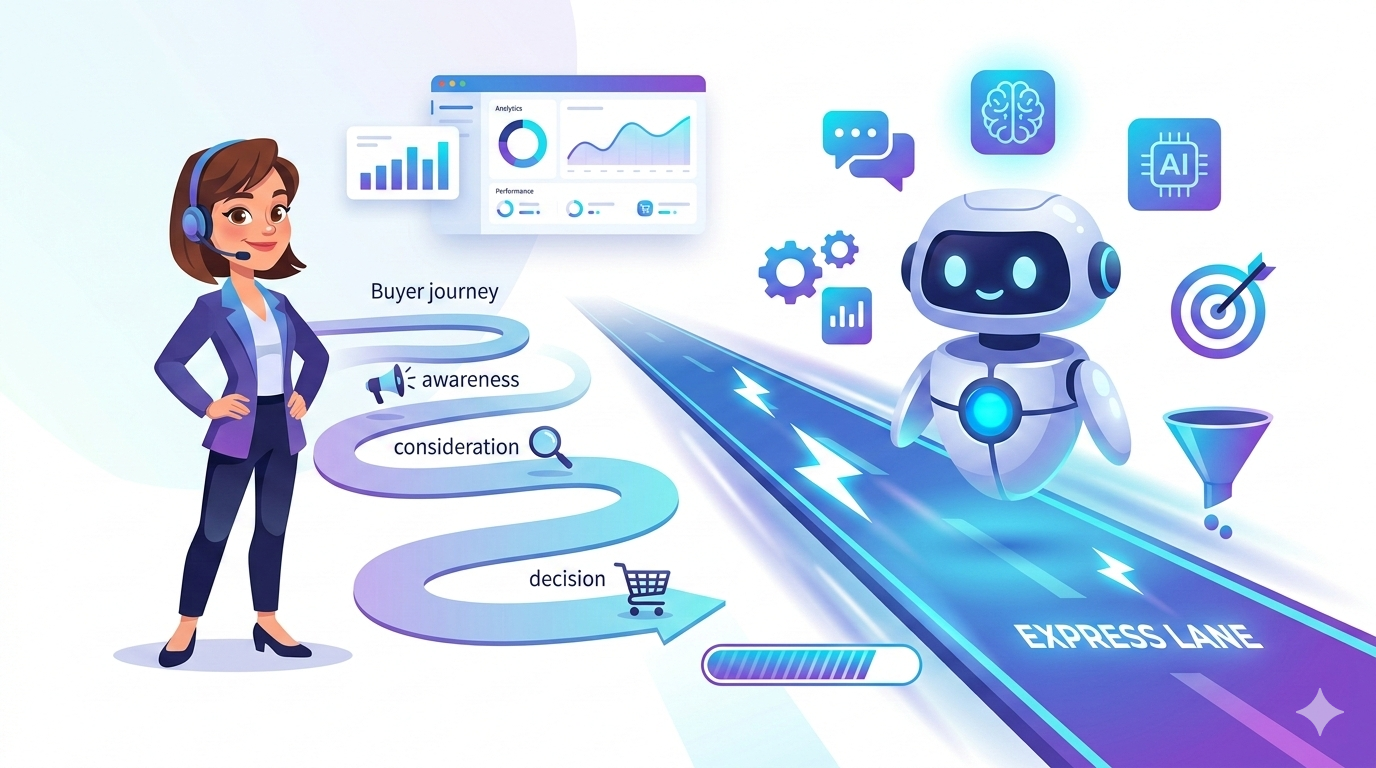
The buyer journey is being compressed. The middle of the funnel: awareness, consideration, comparison is collapsing into a single AI interaction.
What remains is the moment of confirmation.
And if your conversion strategy is not built for confirmation, it is built for an audience that no longer exists.
The Old Journey Is Gone. Here Is What Replaced It.
For over a decade, marketers operated on a framework Google introduced in 2011 called the Zero Moment of Truth (ZMOT). The premise was elegant: between the stimulus (an ad, a recommendation) and the purchase, consumers made a detour online. They searched, compared, read reviews, and validated before ever engaging a vendor.
ZMOT reshaped digital marketing. It made SEO critical, content marketing essential, and review management non-negotiable. The buyer was doing research, and brands that showed up helpfully during that research won.
If you want to understand how to show up effectively during that research phase, my earlier piece on SEO-to-CRO: How SMEs Can Build Landing Pages That Rank and Convert breaks down exactly how to build pages that capture organic traffic and convert it, a foundation worth having before the AI layer compresses it further.
Now, something fundamental has shifted. The buyer still has a ZMOT. The difference is that AI is now completing it for them.
“Rather than navigating through lists of links, buyers are presented with AI-generated insights tailored to their needs, enabling a more direct and efficient decision-making process.” – Ironpaper Research, 2024
When a buyer types “best CRM for a 20-person sales team” into ChatGPT, they do not receive ten blue links. They receive a synthesised answer: a shortlist, a comparison, a recommendation, all generated in seconds. The weeks-long research journey that once defined B2B consideration has been compressed into a single prompt.
The data is unambiguous:
87% of B2B software buyers say AI chatbots have changed how they research.
50% of buyers now start their buying journey in an AI chatbot, not Google Search.
29% start research via LLMs more often than Google.
2 in 3 buyers prefer engaging with salespeople only in later stages, up 17 percentage points from 2024
The research phase has not just shortened. For a growing segment of buyers, it has been outsourced entirely to AI.
The New Buyer Psychology: Confirmation, Not Consideration
Understanding what this shift means requires moving beyond traffic metrics and into buyer psychology.
Because the structural change in how people research is producing a corresponding change in how they think when they arrive at your site.
The traditional conversion funnel was built on a simple assumption: the visitor needs to be informed, then interested, then persuaded. Your landing page had to do all of that work. It was a brochure, an educator, and a salesperson rolled into one.
The AI-era buyer arrives in a different psychological state. They are not in discovery mode. They are in validation mode. They already believe a solution like yours exists. They already understand the category. They may already have a shortlist that includes you. What they need from your landing page is not explanation: it is confirmation.
Confirmation that you understand their specific problem. Confirmation that you are credible. Confirmation that choosing you is the low-risk, high-upside decision. Confirmation that the AI’s recommendation was sound.
AI pre-educates buyers before the click. Your landing page is no longer the beginning of the journey. It is the final checkpoint before conversion.
This psychological shift has a direct and largely unmeasured cost. If your CRO strategy is built around educating buyers who already know the category, you are creating friction, not eliminating it. Every paragraph that explains what your product does is a paragraph that makes an informed buyer wait for what they actually need: a reason to trust you and act now.
Journey Compression Is Producing Counterintuitive Results, and New Risks
Here is the paradox that makes this shift so strategically important: AI-driven journey compression is simultaneously improving and threatening conversion performance, depending entirely on how well your strategy has adapted.
The Good News
Visitors arriving through AI-mediated research are more qualified. A benchmark analysis of 16,446 campaigns found that while overall click volume declined across nearly all query types in 2025, 65% of industries saw improved conversion rates. Fewer clicks, higher intent, better outcomes, for those who were ready.
The 6sense 2025 B2B Buyer Experience Report reinforces this picture. The point of first contact between buyers and sellers shifted from approximately 69% of the way through the buying journey in 2024 to 61% in 2025, buyers are engaging earlier and arriving more prepared. In absolute terms, that is 6 to 7 weeks sooner than just a year prior.
The Dangerous News
The buyers who arrive are better informed, but if your landing page is still built for early-stage consideration, you will lose them faster than ever. A well-educated buyer has no patience for content that re-explains what they already know. They came for confirmation. If they cannot find it in seconds, they leave.
Equally dangerous: the awareness stage is being captured by AI before a buyer ever reaches your site. According to Kalicube analysis, commercial queries triggering AI Overviews jumped from 8.15% to 18.57% between October 2024 and late 2025, a near doubling in one year. Transactional queries saw a similar leap. The AI is moving down the funnel.
For brands not cited in AI answers, the implication is stark: if the AI does not include you in its shortlist, many buyers will never know you exist. The top-of-funnel awareness task is no longer just about ranking on Google. It is about being mentioned, referenced, and recommended by AI systems that are now the primary research interface for a growing majority of buyers.
What This Means for Conversion Strategy: A Framework Shift
If the buyer journey has changed structurally, conversion strategy must change structurally. The fundamental design logic of how your pages, funnels, and offers are built needs to reflect the new buyer psychology.
Here is the framework I use with SME clients navigating this shift:
- Stop Optimising for Persuasion. Start Optimising for Precision.
Persuasion-focused CRO assumes the visitor needs convincing. Precision-focused CRO assumes the visitor knows what they want, and your job is to make the match unmistakably clear, instantly.
Precision means specificity. Not “we help businesses grow” but “we help D2C e-commerce brands reduce cart abandonment by 30% in 90 days.”
Not “trusted by hundreds of clients” but “143 Melbourne-based professional services firms use this system.”
When an AI-informed buyer lands on a page that immediately and precisely mirrors the problem they described to ChatGPT, the cognitive load drops to near zero. In a compressed journey, it is the difference between conversion and abandonment.
- Redesign Your Above-the-Fold for Confirmation, Not Introduction.
Traditional landing page logic puts the value proposition above the fold, explaining what you do, who you help, and why you are different. That logic was built for buyers who did not know you existed.
The AI-era buyer often already knows your category. Your above-the-fold real estate should answer the confirmation questions running in their mind: Is this exactly what I was told it was? Is this credible? What happens next, and is it easy?
This means leading with outcome-specific language matched to the intent of your AI-visible queries. It means placing your most credible proof, not just logos, but specific measurable results, in the first viewport. And it means making the next step so clear and low-friction that a buyer in confirmation mode can act in a single decision.
- Align Your Content Hierarchy to the New Funnel Sequence.
In the old funnel: Awareness → Consideration → Decision. Your landing page served consideration and helped move buyers toward decision.
In the compressed funnel: AI handles Awareness + Consideration → Buyer arrives at Confirmation → Decision. Your landing page now serves only the confirmation-to-decision moment.
This reordering has direct implications for what content goes where. Proof of results should appear earlier than product explanation. Objection handling belongs in the first half of the page, not buried below the fold. Social proof should be specific and verifiable, not “thousands of happy customers” but named companies with measurable outcomes. FAQ sections should address post-AI concerns, implementation, risk, comparison to alternatives, not basic category education.
- Build Your Brand Into the AI Research Layer.
The most underappreciated CRO opportunity right now is not on your landing page. It is in the AI research layer that precedes your landing page.
G2’s 2025 research found that generative AI chatbots and software review sites are the top two sources influencing vendor shortlists, beating vendor websites, market research firms, and independent content. If your brand is not appearing in those AI-generated shortlists, you are being filtered out before the click.
Answer Engine Optimisation (AEO), structuring your content so that AI systems cite, reference, and recommend you is rapidly becoming the new top-of-funnel. For SMEs, this means investing in verifiable, structured, specific content that AI can parse and trust. Reviews, case studies with measurable outcomes, authoritative third-party mentions, and clear entity authority all feed the AI layer that is now generating your first impression.
- Use Friction Strategically, Not to Slow Down, But to Signal Fit.
One of the risks of optimising entirely for speed is losing the qualification that friction provides. Not all friction is bad. The right friction: a question that filters for the buyer’s specific context, a customised path based on company size or industry is a signal of precision, not an obstacle.
When a well-informed buyer encounters a landing page that asks a highly specific qualifying question (“What is your current monthly cart abandonment rate?”), they experience that as relevance, not friction. It tells them: this solution is built for someone like me.
Strategic micro-friction, the kind that helps high-intent buyers self-select into the right conversion path is often more powerful in a compressed journey than fully frictionless pages designed for broadly unqualified traffic.
The Practical CRO Audit for an AI-Compressed World
Translating this framework into immediate action starts with an honest audit of your existing conversion assets. Here are the five questions I ask first when working with a new client:
- Does your above-the-fold content assume the visitor needs education, or assumes they need confirmation? If your headline introduces the category rather than speaks directly to the problem an AI-primed buyer already knows they have, it is time to rewrite from confirmation logic, not introduction logic.
- Is your social proof specific and verifiable, or generic and decorative? AI-informed buyers have higher trust calibration. They have been presented with synthesised comparisons. A logo wall does not move them. Named outcomes with real numbers do.
- Where are your objection-handling elements positioned on the page? If they are below the fold, you are answering questions too late for buyers who have already made up their mind to leave. Primary objections: cost, complexity, implementation risk belong in the first half of every high-intent landing page.
- Is your brand visible and cited in AI-generated search results for your category? Search your core intent queries in ChatGPT, Perplexity, and Google AI Overviews. Is your brand on the shortlist? If not, that is a funnel problem before the funnel even starts.
- Does your CTA sequence match the decision speed of an informed buyer? Buyers arriving from AI research are often closer to a decision than buyers arriving from broad keyword searches. Multi-step nurture sequences designed for cold traffic create unnecessary delay for warm, AI-primed visitors. Consider whether a direct, high-confidence CTA, a consultation, a demo, a trial is appropriate earlier in the sequence than your current funnel assumes.
What Stays the Same (And Why That Matters)
In the urgency to adapt to AI-driven compression, there is a risk of overcorrecting. Some fundamentals of conversion psychology do not change because the research medium has changed.
The 6sense 2025 B2B Buyer Experience Report found that despite all the compression and AI adoption, 80% of seller conversations are still buyer-initiated, and the vendor contacted first wins 8 out of 10 deals. Trust, credibility, and clarity remain the decisive factors. AI has not replaced human judgment in purchase decisions, it has accelerated the path to the moment where human judgment activates.
Specificity still outperforms vagueness. Outcomes still outperform features. Proof still outperforms claims. These are not principles that AI disrupts, they are principles that AI makes more urgent, because the compressed journey means there is less time and space to recover from vague, feature-heavy, credibility-thin messaging.
The underlying CRO logic: understand the buyer’s psychology at the moment of conversion, remove friction, provide the right information at the right time remains intact. What has changed is what “the right information” is, and what “the right time” means in a world where the buyer arrives further along the journey than they ever have before.
The Strategic Implication
We are at an inflection point in conversion strategy. The brands that will win in the next three years are not necessarily the ones with the best landing pages in the traditional sense. They are the brands that understand where in the buyer’s mind they are arriving, and design every element of the conversion experience accordingly.
That means building brand presence in the AI research layer. It means designing landing pages for confirmation, not education. It means treating proof and precision as first-order conversion priorities, not supporting elements. And it means measuring what actually drives decisions in a compressed journey, not what worked in a longer one.
The buyer journey has changed. The question is whether your conversion strategy has.
About Vishwas Thakkar
Vishwas Thakkar is a Conversion Rate Optimisation and digital growth strategist specialising in SMEs. His work sits at the intersection of buyer psychology, AI-driven discovery, and measurable revenue outcomes. He works with founders and marketing leaders who want conversion strategy built for how buyers actually behave, not how they used to.
References
G2. (2025). 2025 buyer behavior report: AI now means “always included”.
G2. (2024). How AI chat is rewriting B2B software buying.
6sense. (2025). 2025 B2B buyer experience report.
Ironpaper. (2024). Generative AI is transforming the buyer journey in 2025.
Luxid Group. (2025). How AI is transforming the B2B buyer journey.
UnboundB2B. (2026). How AI Overview is transforming demand generation in 2026.
Search Engine Land. (2026). 4 strategic paid search pivots to survive Google’s AI Overviews.
Kalicube / Barnard, J. (2025–2026). The great contraction: From the zero moment of truth to the zero-sum moment in AI.
DesignRush. (2026). Transactional queries power 14% of AI Overviews.
Gartner Digital Markets. (2024). Research rundown: Trends in the 2025 software buyer journey.
Lecinski, J. / Google. (2011). Winning the zero moment of truth.