The Rise of AI Agents: When Software Starts Acting on Behalf of Users
Mar 18, 2026 | 3 Min Read | 1676 Views

Imagine waking up on a Monday morning. Before you’ve even poured your first coffee, your AI agent has already reviewed your inbox, flagged the three emails that actually need your attention, rescheduled a meeting that conflicted with your focus block, drafted a follow-up to a client you forgot about last Friday, and ordered the office supplies you’ve been meaning to restock for two weeks.
No, this isn’t science fiction. This is the world AI agents are building, right now.
For most of the past decade, AI was about generating things: text, images, code, summaries. You gave it a prompt, it gave you an output. It was a clever, incredibly fast autocomplete. Useful. But fundamentally passive.
AI agents are something else entirely. They don’t just respond, they act. They plan multi-step tasks, use tools, make decisions, and execute real-world actions autonomously. They are software that behaves on your behalf.
“AI agents can accomplish complex tasks on a user’s behalf with minimal intervention, from sales prospecting to compliance decisioning.”, CB Insights, 2025
We are at an inflection point. Research papers mentioning “AI Agent” or “Agentic AI” in 2025 more than doubled the total from all of 2020 to 2024 combined. Funding to AI agent startups nearly tripled in 2024. And 62% of companies now report at least experimenting with them, according to McKinsey’s State of AI Global Survey.
So: what exactly are AI agents, how do they work, why does this matter for you, and what should you actually be doing about it? Let’s dig in.
The Difference Between a Chatbot and an Agent (It’s Bigger Than You Think)
Here’s a question worth sitting with: if you ask ChatGPT to book you a flight, it will tell you how to book a flight. If you ask an AI agent to book you a flight, it will book the flight.
That’s the core distinction. Chatbots are reactive. Agents are proactive. A chatbot generates outputs in response to inputs. An agent defines a goal, creates a plan to achieve it, uses available tools (web browsers, APIs, code execution, databases), checks its own outputs, adapts when things go wrong, and keeps going until the task is complete.
IBM’s research team describes the distinction clearly: “AI agents differ from traditional AI assistants that need a prompt each time they generate a response. In theory, a user gives an agent a high-level task, and the agent figures out how to complete it.”
The Four Pillars of an AI Agent
- Perception, The agent takes in information from its environment (your calendar, the web, a database, screen content)
- Planning, It reasons through how to achieve a goal, often breaking it into sub-tasks
- Action, It uses tools: browsers, APIs, code execution, file systems, external services
- Memory, It retains context across steps, and sometimes across sessions, to stay on track
What makes 2025 special is that all four of these pillars have become cheap and reliable enough to combine. The explosion of capable foundation models, low-cost API infrastructure, and standardized tool-calling frameworks (like Anthropic’s Model Context Protocol) has collapsed the barrier to building agents that actually work.
What AI Agents Are Actually Doing in the Wild
It’s tempting to describe AI agents in the abstract. It’s more useful to show you what they’re doing right now, in real products used by real companies.
OpenAI’s Operator: Browsing the Web on Your Behalf
Launched to US ChatGPT Pro users in early 2025, OpenAI’s Operator runs inside a secure sandboxed browser in the cloud. It can navigate websites, click buttons, fill forms, and complete web-based tasks autonomously, ordering groceries, booking travel, purchasing tickets. The system asks for your approval on sensitive actions like financial transactions, but otherwise operates independently. It’s the first mainstream product that genuinely blurs the line between “chatbot” and “digital employee.”
Amazon’s Nova Act: Your AI Shopping Concierge
Amazon’s Nova Act is purpose-built to perform actions in a web browser. The headline use case: tell it to find you the cheapest 5-pack of blue socks, and it will search multiple websites, compare sellers, and execute the purchase, payment and shipping included. Amazon envisions this as an evolution of Alexa from voice assistant into autonomous commerce agent.
Enterprise Agents: The Invisible Workforce
The quieter revolution is happening inside enterprises. CB Insights reports that LLM-based agent systems are now accomplishing tasks from sales prospecting to compliance decisioning. The city of Kyle, Texas deployed a Salesforce AI agent for 311 customer service in March 2025. The IRS announced it would use Agentforce for the Office of Chief Counsel. BakerHostetler, a major US law firm, deployed AI research agents that cut research-related hours by 60%.
The real question isn’t whether AI agents can do the job. It’s whether your organization is ready to let them, and what “human oversight” actually means in practice.
The Numbers Behind the Hype
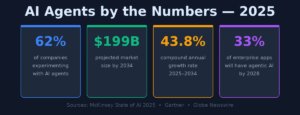
Hype cycles can deceive. So let’s look at the research with clear eyes.
- 62% of companies are at least experimenting with AI agents (McKinsey State of AI, 2025)
- 88% of enterprises report regular AI use in at least one business function, up from 78% a year prior
- 23% of respondents say their organizations are actively scaling an agentic AI system
- Gartner projects 33% of enterprise software will include agentic AI by 2028, up from less than 1% in 2024
- Gartner further predicts 40% of enterprise applications will feature task-specific agents by end of 2026
- The global agentic AI market sits at $5.25 billion in 2024, projected to reach $199 billion by 2034 at 43.8% CAGR
- McKinsey estimates AI agents could add $2.6 to $4.4 trillion in annual value across business use cases
But here is the honest counterpoint: Gartner also predicts that over 40% of agentic AI projects will be cancelled by end of 2027, due to escalating costs, unclear business value, or inadequate risk controls. The technology is real. The results are real. But so are the failure modes.
The Trust Problem: When Your Agent Does Something You Didn’t Quite Mean
Here is the uncomfortable question at the center of all of this: how much do you trust a piece of software to act on your behalf?
It’s not theoretical. IBM’s researchers describe an agentic AI scenario that should give every CTO pause: “Using an agent today is basically grabbing an LLM and allowing it to take actions on your behalf. What if this action is connecting to a dataset and removing a bunch of sensitive records?”
The MIT CSAIL 2025 AI Agent Index, one of the most comprehensive analyses of agentic systems to date, found some striking gaps. Of the 30 major agents analyzed, only 4 disclosed any agentic safety evaluations. 25 out of 30 agents disclosed no internal safety results. Browser-based agents like Google’s Autobrowse operate at high autonomy levels with limited mid-execution intervention. And more than half of the agents tested provide no specific documentation on how they handle robots.txt, CAPTCHAs, or other web conduct standards.
“There’s a significant transparency gap between capability and safety disclosure. Developers share far more about product features than safety practices.”, MIT CSAIL, 2025 AI Agent Index
The researchers labeled this “safety washing”, publishing high-level ethics frameworks while selectively disclosing the empirical evidence needed to assess real risk.
This isn’t a reason to avoid agents. It’s a reason to be thoughtful about deploying them. Deloitte’s research shows that regulation and risk have become the number one barrier to agentic AI deployment, rising 10 percentage points in concern in a single year.
What Good Governance Looks Like
The organizations navigating this well share a few common practices:
- Real-time monitoring, Know what your agents are doing, continuously, not just in post-mortems
- Kill switches, The ability to halt agent actions immediately when something goes wrong
- Audit trails, Comprehensive logs of every action, decision, and tool call
- Approval gates, Human-in-the-loop checks for high-stakes or irreversible actions
- Principle of least privilege, Agents should only have access to what they need for their specific task
This connects directly to something we explored in our earlier piece on conversion rate optimization and the hidden cost of inaction, the same bias that leads businesses to over-invest in traffic acquisition while neglecting optimization applies here. Companies are rapidly adding agents without building the governance infrastructure to make them safe. The price of that shortcut shows up later, and it’s steep.
Multi-Agent Systems: When Agents Talk to Each Other
The really mind-bending frontier isn’t individual agents. It’s agents that coordinate with other agents.
Multi-agent architectures already represent 66.4% of the market focus in agentic AI. The idea is simple: complex tasks get broken into sub-tasks, each handled by a specialist agent, coordinated by an orchestrator agent. One agent searches the web. Another analyzes what it finds. A third drafts a report. A fourth quality-checks it and sends it.
Frameworks for building these systems, LangChain, Microsoft AutoGen, OpenAI Swarm, Google’s Agent2Agent protocol, are proliferating rapidly. The Linux Foundation announced the Agentic AI Foundation (AAIF) in December 2025, specifically to ensure inter-agent communication standards evolve transparently.
Think of multi-agent systems like a well-run team. No single person (or agent) knows everything. The magic is in the coordination, the handoffs, and the shared goal.
For business leaders, the practical implication is significant: we’re moving from “one AI that does everything” to “a fleet of AIs that handle different functions.” The organizational design challenge shifts from “how do I use AI” to “how do I manage a digital workforce.”
The Economic Shift: Sellers Are Already Optimizing for AI Buyers
Here is something that should stop you mid-scroll: sellers are beginning to optimize their product descriptions not for human buyers, but for AI agents that will buy on their behalf.
Research published in late 2025 found that AI agents exhibit strong position effects, they heavily favor products at the top of lists, and that sellers can optimize their listings to capture agent attention. The researchers warned about what they called “agentic e-commerce,” a scenario with serious implications for consumer protection and antitrust law.
PayPal and Perplexity have partnered to enable one-click checkout within AI chat. Mastercard and Visa both announced capabilities for agents to make purchases on consumers’ behalf. Walmart has publicly stated it expects AI agents to become its next major customer segment.
AI agents are no longer just assisting, they’re purchasing, committing, and transacting on our behalf. The economics of commerce are quietly being rewritten.
For marketers and business owners, this has immediate implications. If agents increasingly intermediate the discovery and purchase journey, the question changes from “how do humans find and trust us” to “how do AI agents evaluate and select us.” SEO and CRO strategies built entirely for human psychology will need to evolve.
So What Should You Actually Do? A Practical Framework
Whether you’re an individual professional, a small business owner, or an enterprise leader, here is a grounded starting framework:
Start with Repetitive, Low-Stakes Tasks
The best initial use cases for agents are tasks that are repetitive, rule-based, low-risk if they go wrong, and time-consuming for humans. Calendar management, inbox triage, data extraction from documents, first-draft content generation, meeting summaries, these are where agents deliver immediate ROI without requiring complex governance.
Build Governance Before You Scale
Every analyst firm says the same thing: organizations that skip governance end up funding expensive failures. Before you deploy an agent into anything consequential, define what it can and cannot do, build monitoring, and establish your kill switch. This isn’t bureaucracy, it’s the difference between a tool and a liability.
Choose Platforms with Documented Safety Frameworks
The MIT CSAIL research is clear: most vendors lack transparency on safety. Prefer platforms that publish their safety evaluations, have documented compliance standards, and participate in emerging governance initiatives like the AAIF. Among frontier labs, Anthropic, OpenAI, and Google currently lead on documented agentic safety practices.
Think in Terms of Workflows, Not Tasks
Gartner’s guidance is pointed: “To get real value from agentic AI, organizations must focus on enterprise productivity, rather than just individual task augmentation.” The ROI from replacing a single task is incremental. The ROI from redesigning an entire workflow around agents is transformational.
Deloitte forecasts that 25% of companies using generative AI will launch agentic AI pilots in 2025, rising to 50% by 2027. The window to be an early mover is still open. But it’s closing.
Frequently Asked Questions
Q1. What’s the simplest way to explain an AI agent to a non-technical colleague? Think of a traditional chatbot as a very smart calculator, you give it an input, it gives you an output, done. An AI agent is more like a very capable new hire. You give it a goal, and it figures out how to get there, using whatever tools are available, checking its own work, and adapting when things don’t go as planned. The key difference is autonomy: the agent doesn’t wait to be prompted at every step.
Q2. Are AI agents reliable enough to use in real business workflows? For narrow, well-defined tasks in controlled environments, yes, and the results can be significant. For complex, open-ended tasks with high-stakes consequences, we’re still in early days. The honest answer from IBM’s researchers: “I definitely see AI agents heading in this direction, but we’re not fully there yet.” Start with low-risk use cases, build confidence, and expand from there.
Q3. What are the biggest risks businesses should watch for? Three areas stand out: (1) Data handling, agents with broad system access can accidentally read, copy, or modify sensitive data. (2) Unintended actions, an agent trying to be helpful can take actions with consequences that weren’t intended. (3) Security vulnerabilities, security researchers have catalogued 15 distinct threat categories unique to agentic systems, including memory poisoning and privilege compromise. Strong governance, audit trails, and least-privilege access are the mitigation.
Q4. How does this affect my digital marketing and conversion strategy? Significantly and soon. If AI agents increasingly mediate how consumers discover and purchase products, the buyers you’re optimizing for aren’t just humans anymore. The SEO and conversion rate optimization strategies that work for human psychology will need to evolve. This is an area we’ve covered in depth, the core principle of understanding who you’re actually optimizing for applies whether that audience is human or agentic.
Q5. What’s the difference between agentic AI and robotic process automation (RPA)? RPA follows fixed, scripted rules, it automates what humans already know how to do in a very defined sequence. Break from the script and RPA breaks. Agentic AI can reason, adapt, and handle novel situations. It doesn’t need every step pre-defined. Many vendors are “agent washing”, rebranding legacy RPA products as AI agents. Gartner estimates that of the thousands of vendors claiming to offer agentic AI, only about 130 are the real thing.
Q6. Will AI agents replace jobs? The more precise framing: agents will replace tasks, and that will reshape jobs. The tasks most at risk are the ones that are also the most tedious, repetitive data entry, routine reporting, formulaic communication. The tasks that will grow in value are judgment, creativity, relationship management, and strategy. Gartner projects that 15% of day-to-day work decisions will be made autonomously by 2028. The implication isn’t “fewer people” so much as “different work.”
References
CB Insights. (2025). What’s next for AI agents? 4 trends to watch in 2025. CB Insights Research.
Gartner. (2025, June 25). Gartner predicts over 40% of agentic AI projects will be canceled by end of 2027 [Press release].
Gartner. (2025, August 26). Gartner predicts 40% of enterprise apps will feature task-specific AI agents by 2026 [Press release].
Gartner. (2025, August 5). Gartner Hype Cycle identifies top AI innovations in 2025 [Press release].
IBM. (2025, November 18). AI agents in 2025: Expectations vs. reality. IBM Think Insights.
McKinsey & Company. (2025). The state of AI in 2025: Agents, innovation, and transformation. McKinsey Global Institute.
MIT Computer Science and Artificial Intelligence Laboratory (CSAIL). (2025). 2025 AI Agent Index. Massachusetts Institute of Technology.
ML Science. (2025, April 29). Developments in AI agents: Q1 2025 landscape analysis. The Science of Machine Learning & AI.
Datagrid. (2025, December 18). 26 AI agent statistics (adoption + business impact). Datagrid Blog.
Landbase. (2026, January 19). 39 agentic AI statistics every GTM leader should know in 2026. Landbase Blog.
Joget Inc. (2026). AI agent adoption in 2026: What the analyst data shows. Joget Blog.
Consumer Reports Innovation. (2025). AI news & marketplace roundup: Autonomous shopping & the agent economy.
Wikipedia contributors. (2026, March). AI agent. In Wikipedia, The Free Encyclopedia.