Budget CRO: Low-cost Strategies That Deliver Big Wins (For Small Teams and Fast Timelines)
Jan 16, 2026 | 3 Min Read | 2163 Views

Rachel managed marketing for a mid-sized software company in Melbourne. Her CEO had just approved a $120,000 annual marketing budget, but $110,000 of it was already committed to paid advertising. When she proposed launching a conversion rate optimization program, the response was swift and predictable: “We don’t have budget for CRO. Focus on getting more traffic.”
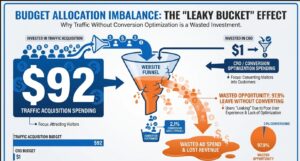
The irony wasn’t lost on Rachel. Her company spent $92 on acquiring visitors for every $1 spent on converting them, mirroring the industry average according to recent data analysis of marketing budgets. Yet their conversion rate sat at 2.1%, meaning 97.9% of their expensive traffic generated zero revenue.
Faced with this reality, Rachel did something unconventional. She stopped asking for a conversion rate optimization (CRO) budget and instead started implementing zero-cost optimization strategies using free tools and her existing team’s hours. Within 90 days, she increased conversion rates from 2.1% to 4.3%, effectively doubling revenue from organic traffic without spending a single additional marketing dollar.
Her success wasn’t accidental. It came from understanding that conversion rate optimization doesn’t require expensive tools, specialized agencies, or massive budgets. The highest-impact improvements often come from systematic thinking, behavioral psychology, and strategic prioritization, not from premium software subscriptions.
The Budget Trap That Kills CRO Before It Starts
Here’s the uncomfortable truth about conversion rate optimization: most businesses understand its value but never actually implement it. Research on CRO adoption barriers reveals that 68% of small businesses lack any dedicated CRO strategy, despite knowing that companies using structured optimization programs report an average ROI of 223%.
This gap between understanding and implementation stems primarily from misaligned expectations about resource requirements. When marketing leaders hear “CRO program,” they envision enterprise-level commitments involving dedicated teams of specialists, expensive testing platforms costing thousands monthly, statistical software packages, heatmapping and session recording tools, user research facilities, and months of runway before seeing results.
Faced with these perceived requirements, small teams with limited budgets rationally conclude that CRO isn’t feasible for their situation. They return to spending money on traffic acquisition, watching their conversion rates stagnate while competitors with smarter optimization approaches steadily gain ground.
However, this conclusion rests on a flawed premise. The most impactful CRO improvements rarely require expensive tools or large teams. A study examining barriers to CRO implementation found that while companies frequently cited “resources” as their primary constraint, deeper analysis revealed knowledge gaps and prioritization failures as the actual limiting factors, not budget availability.
The real barrier isn’t money. It’s knowing which high-impact, low-cost strategies to implement first, and how to execute them systematically without enterprise-level resources.
Why Budget CRO Actually Works Better for Small Teams
Counterintuitively, small teams with limited budgets often achieve better CRO results than large organizations with substantial resources. Three factors explain this advantage.
- Forced prioritization eliminates waste. When you can’t afford to test everything, you’re compelled to identify the highest-impact opportunities first. Enterprise CRO programs often test incrementally, running dozens of minor variations that produce marginal improvements. Budget-constrained teams must focus ruthlessly on changes likely to generate significant uplift, leading to bigger wins per test.
- Faster decision-making accelerates learning. Small teams can implement changes in days that take large organizations weeks or months to approve. This speed advantage compounds over time. While a corporate team debates whether to run a single test, an agile small team has already implemented, measured, and iterated three improvements.
- Proximity to customers provides clearer insights. In large organizations, CRO specialists may never directly interact with customers. Small teams often have founders, product managers, or marketers who regularly speak with users. This direct exposure to customer pain points, objections, and decision criteria generates optimization insights that no analytics dashboard can provide.
These structural advantages mean small teams can compete effectively against much larger competitors through smart, systematic optimization, even without matching their tool budgets or team sizes.
Step 1: Prioritize Problems Worth Solving (The ICE Framework)
The fundamental mistake in budget CRO is attempting to optimize everything simultaneously. This spreads limited resources across dozens of minor improvements, producing minimal impact. Instead, apply the ICE prioritization framework to identify which problems deserve immediate attention.
ICE stands for Impact, Confidence, and Ease. For each potential optimization, score it on these three dimensions using a simple 1-10 scale.
- Impact measures how significantly the change could improve conversions if successful. Optimizing your homepage headline scores higher than adjusting footer link colors because it affects more visitors and influences their first impression of your value proposition. Improving your checkout flow scores higher than refining your blog sidebar because it directly impacts revenue.
- Confidence reflects how certain you are that the change will actually improve results. If user research consistently shows visitors don’t understand your pricing, confidence in a pricing page redesign should be high. If you’re guessing based on intuition without supporting evidence, confidence should be low.
- Ease quantifies implementation difficulty. Changes requiring no developer time score higher than those needing backend integration. Updates you can make in hours score higher than projects requiring weeks.
Calculate an ICE score by averaging these three numbers. Focus your limited time and budget on opportunities with the highest combined scores. This systematic prioritization prevents the common trap of working on easy but low-impact changes while ignoring difficult but transformational improvements.
For a small team with no budget, this might mean focusing first on rewriting your homepage value proposition (high impact, high confidence based on user feedback, high ease since it’s just copy changes) rather than building a sophisticated recommendation engine (potentially high impact, low confidence without testing, very low ease due to technical complexity).
Step 2: Mine Existing Data for Zero-Cost Insights
Before spending money on research tools, extract maximum value from data you already have. Most businesses sit on actionable conversion insights but never analyze them systematically.
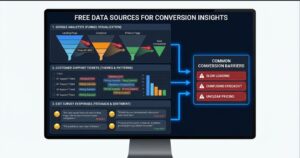
Google Analytics provides conversion funnel analysis at no cost. Set up goals and funnels to visualize exactly where visitors abandon your conversion process. If 60% of users who add items to cart never complete checkout, your optimization priority is obvious. If 80% of pricing page visitors never request a demo, investigate what’s preventing that next step.
Don’t just review aggregate data. Segment by traffic source, device type, and user behavior to identify specific problem areas. Perhaps your mobile conversion rate significantly lags desktop, suggesting mobile experience issues. Maybe organic search visitors convert at higher rates than social traffic, indicating targeting or messaging alignment differences worth understanding.
Customer service conversations contain conversion optimization gold. Every support ticket, sales call, and customer complaint reveals friction points in your user experience. Create a simple spreadsheet where team members log common questions, objections, and confusion points they encounter. After collecting 20-30 entries, patterns emerge clearly.
If seven different prospects ask “Does this integrate with Salesforce?” during sales calls, that integration capability should be prominently featured on your landing page rather than buried in documentation. If customers repeatedly struggle with a specific feature during onboarding, that friction point is preventing conversions for prospects who never even get far enough to contact support.
Exit surveys require no budget but generate direct feedback. Use free tools like Google Forms to create simple exit surveys triggered when visitors are about to leave your site. Ask one focused question: “What stopped you from [converting] today?” The responses provide qualitative insights into conversion barriers that quantitative analytics can’t reveal.
You’ll discover that some visitors leave because they’re not ready to buy yet (not an optimization problem), while others exit because your pricing is unclear, they couldn’t find specific information they needed, or they have concerns about security or legitimacy that your site doesn’t address. These are all directly actionable insights requiring no research budget to obtain.
Step 3: Fix High-Impact Technical Barriers First
Technical issues often create the biggest conversion barriers while being completely free to fix if you allocate time appropriately. These problems silently destroy conversions across your entire site, making their resolution more valuable than almost any design or copy improvement.
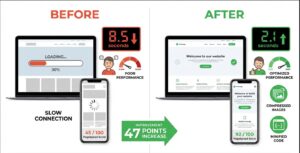
Page speed optimization delivers measurable conversion improvements and costs nothing but time. Research on user experience and conversion consistently shows that page load time significantly impacts conversion rates, with delays beyond 3 seconds causing substantial visitor abandonment.
Use Google’s free PageSpeed Insights to identify specific performance problems. Common high-impact fixes include compressing images (use free tools like TinyPNG), removing unused JavaScript and CSS, implementing browser caching, and minifying code. Most of these improvements require no special expertise, just systematic work through the identified issues.
For small teams, focus on mobile performance first since mobile users typically experience slower load times and represent an increasing share of traffic. A one-second improvement in mobile load time can generate conversion rate increases of 8% or more according to conversion rate statistics.
Broken forms prevent conversions directly yet frequently go undetected because businesses test their own forms while logged in as administrators. Create a dummy email account and complete every form on your site as a real visitor would. You’ll often discover fields that don’t validate correctly, error messages that don’t display, or success confirmations that never trigger.
Research examining e-commerce checkout abandonment found that technical form issues contribute significantly to the 69.8% average cart abandonment rate. Simply ensuring your forms work correctly across all browsers and devices can generate immediate conversion improvements.
Mobile responsiveness issues create conversion barriers that desktop testing never reveals. Load every important page on your site using an actual mobile device, not just browser responsive mode. You’ll likely find buttons too small to tap accurately, text overlapping or becoming illegible, forms extending beyond screen boundaries, or navigation elements that don’t function correctly on touch interfaces.
Academic research on user experience design emphasizes that mobile optimization requires specific attention to touch targets, content hierarchy, and interaction patterns that differ substantially from desktop experiences. Fixing these issues costs nothing beyond testing time but directly impacts conversion rates for increasingly dominant mobile traffic.
Step 4: Implement Copy Changes That Move Metrics
Copywriting changes represent the highest-ROI optimization opportunity for budget-constrained teams because they require zero technical implementation, can be tested immediately, and often generate substantial conversion improvements when done strategically.
Lead with concrete outcomes, not features. Compare these two headlines for the same project management software:
- Feature-focused: “Collaborative project management platform with task tracking, file sharing, and team communication.”
- Outcome-focused: “Finish projects 40% faster by eliminating 6 hours of weekly status meetings.”
The second headline works better because it quantifies a specific benefit and addresses a real pain point (wasted time in meetings). Visitors immediately understand what they gain rather than having to translate features into personal value.
Research on persuasive communication in digital marketing shows that specificity significantly increases credibility and conversion rates. Replace vague claims with precise numbers and outcomes whenever possible. Instead of “save time,” specify “reduce reporting time from 4 hours to 20 minutes weekly.” Instead of “increase sales,” quantify “generate 30% more qualified leads in 90 days.”
Address the primary objection directly in your copy. Every product or service faces a dominant objection that prevents conversions. For expensive solutions, it’s cost. For new technologies, it’s complexity or learning curve. For established markets, it’s differentiation from alternatives.
User research examining conversion barriers found that addressing objections proactively significantly reduces abandonment rates. Your copy should acknowledge and counter the primary objection before visitors even formulate it as a concern.
If cost is the barrier, emphasize ROI: “Pays for itself within 60 days through reduced labor costs.” If complexity creates hesitation, highlight simplicity: “No technical expertise required—setup complete in 5 minutes.” If differentiation is unclear, specify your unique advantage: “The only solution built specifically for dental practices, not adapted from generic medical software.”
Simplify your call-to-action copy for clarity. Vague CTAs like “Submit,” “Learn More,” or “Get Started” underperform specific alternatives that communicate exactly what happens next. Replace generic button text with precise action-oriented language: “Download Your Free Guide,” “Start Your 14-Day Trial,” “Schedule Your Free Consultation.”
Analysis of conversion rate optimization across thousands of landing pages reveals that clear, specific CTAs consistently outperform vague alternatives. The improvement comes from reducing uncertainty about commitment level and next steps.
Step 5: Run Low-Budget Tests That Generate Real Learning
Traditional A/B testing platforms cost thousands of dollars monthly and require substantial traffic volume to reach statistical significance quickly. Budget-constrained teams need alternative approaches that generate actionable insights without these resources.
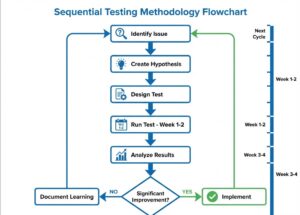
Sequential testing eliminates the need for simultaneous A/B test traffic splitting. Instead of showing version A to 50% of visitors and version B to the remaining 50%, run version A for two weeks, then version B for two weeks, comparing performance between periods.
This approach works best when traffic patterns are relatively consistent and you’re testing substantial changes likely to produce clear signals rather than minor variations requiring precise measurement. For small sites receiving 500-2,000 visitors weekly, sequential testing makes optimization possible when traditional split testing would never reach statistical significance.
Research on conversion optimization methodologies acknowledges that while sequential testing introduces time-based variables, it remains valuable for teams unable to achieve sufficient concurrent traffic volume for traditional split testing.
Before/after analysis provides similar learning when you lack tools for formal testing. Document your baseline conversion rate over a 4-week period to establish a stable average. Implement your optimization change, then measure conversion rates for the subsequent 4 weeks. If you see a sustained improvement of 20% or more, you can be reasonably confident the change generated real impact.
This method isn’t as rigorous as controlled testing, but it’s infinitely better than making changes without any measurement or learning from them. For budget teams, imperfect data that drives decisions beats perfect data that never gets collected because tools cost too much.
Qualitative feedback testing costs nothing and often reveals insights quantitative testing misses. Before launching a major change, share mockups or prototypes with 5-10 representative users and watch them interact with the design while thinking aloud about their experience.
Academic research on user experience methods emphasizes that qualitative testing with small sample sizes reliably identifies usability problems and comprehension issues. You don’t need dozens of test participants to discover that users don’t understand your pricing structure or can’t find your contact information.
Record these sessions (with permission) using free screen recording tools like Loom. The insights from watching real users struggle with or misunderstand elements of your conversion funnel are typically more actionable than aggregate analytics data.
Step 6: Leverage Free Tools Strategically
While enterprise CRO programs use expensive tool suites, budget-conscious teams can accomplish 80% of essential research and optimization using free alternatives.
Microsoft Clarity provides session recordings and heatmaps at no cost with no visitor limits. This tool shows you exactly how real users interact with your site: where they click, how far they scroll, which elements they ignore, and where they experience confusion or friction.
Use Clarity to identify specific usability problems worth fixing. If you notice users repeatedly clicking an element that isn’t clickable, make it clickable or remove it to eliminate confusion. If heatmaps show users never scroll below the fold on a key landing page, move your most important information higher.
Research on user behavior analysis shows that session recordings reveal conversion barriers that aggregate metrics miss. You can observe a visitor adding items to cart, proceeding to checkout, then abandoning after encountering a confusing form field, providing specific direction for optimization.
Google Optimize offers basic A/B testing functionality for free, though it’s being sunset. Alternative free options include open-source testing platforms or implementing simple tests manually using URL parameters to serve different versions to different visitors.
The limitation of free testing tools is typically traffic volume requirements for statistical significance and limited test types. However, for small teams just beginning systematic optimization, these constraints matter less than the learning and iteration culture that free tools enable.
Hotjar’s free tier provides limited heatmaps, recordings, and surveys sufficient for small sites to begin optimization. While enterprise plans offer more sessions and features, the free tier captures enough data for actionable insights if you focus analysis on your highest-traffic pages.
Google Analytics 4 remains the foundational free tool for conversion tracking, funnel analysis, and user behavior measurement. Most teams never fully utilize GA4’s capabilities, focusing on basic traffic metrics while ignoring powerful segmentation, flow visualization, and conversion path analysis that costs nothing to access.
Step 7: Build Organizational Momentum Through Quick Wins
The biggest challenge in budget CRO isn’t technical implementation but maintaining organizational commitment when results take time to materialize. Small teams can’t afford months of work before demonstrating value.
Target quick wins first to build credibility and momentum. Rather than launching with complex, time-intensive optimizations, identify simple changes likely to generate visible improvements within 2-4 weeks.
This might mean starting with copy improvements to your homepage headline and value proposition rather than rebuilding your entire checkout flow. It could mean fixing broken form validation before redesigning the form layout. These changes require less time and generate faster results, creating proof points that justify continued optimization investment.
Research on organizational adoption of CRO programs found that early demonstrable successes significantly increase leadership support and resource allocation for ongoing optimization. Conversely, programs that begin with complex, slow-moving initiatives often get defunded before reaching completion.
Document everything obsessively. Create a simple spreadsheet tracking every optimization: what you changed, why you made the change, the implementation date, baseline metrics, and results after 30 days. This documentation serves multiple purposes.
First, it prevents losing institutional knowledge when team members change roles. Second, it creates a data-driven narrative about CRO’s business impact that justifies future resource requests. Third, it helps you identify patterns in what works (changes addressing specific pain points) versus what doesn’t (aesthetic tweaks without strategic rationale).
Communicate wins broadly without waiting for permission. When an optimization generates measurable improvement, share results with relevant stakeholders via brief email updates or slack messages. These communications should be factual rather than boastful: “Updated pricing page copy based on customer feedback analysis. Conversion from pricing page to demo request increased from 12% to 19% over the past 30 days.”
These regular updates build organizational awareness that CRO generates real business value, making future budget requests more likely to succeed. They also create accountability around ongoing optimization rather than treating it as an optional activity that gets deprioritized when teams are busy.
How We Accelerate Your Budget CRO Success
Even with low-cost strategies, many teams struggle to implement systematic optimization because they lack the structured methodology, prioritization frameworks, and conversion expertise needed to maximize results from limited resources.
Vishwas Thakkar specializes in helping SMEs build high-impact CRO programs without enterprise-level budgets. Our approach combines strategic consulting with hands-on implementation support, focusing on changes that generate measurable ROI quickly.
We help you identify and prioritize your highest-impact optimization opportunities through systematic conversion audits that combine analytics review, user research, and competitive analysis. This strategic foundation ensures your limited time and budget focus on changes most likely to drive meaningful results.
Our team implements proven optimization frameworks adapted to your specific constraints, whether that’s limited developer availability, small traffic volume, or compressed timelines. We’ve developed efficient approaches to testing and optimization that work effectively for small teams.
Most importantly, we transfer knowledge rather than creating dependency. Our goal is building your internal capability to sustain and expand CRO efforts over time, not locking you into ongoing agency relationships. We document our process, explain our strategic rationale, and train your team on the frameworks and tools enabling continued optimization.
Schedule a free consultation to discuss how strategic CRO can transform your conversion performance without requiring massive budget increases. We’ll analyze your current conversion funnel, identify immediate opportunities, and show you exactly how systematic optimization can improve your business results.
FAQ
1. How much should I budget for CRO if I’m just getting started?
For teams new to CRO, start by reallocating 5-10% of your existing marketing budget toward optimization rather than requesting new funding. This might mean reducing paid advertising spend by $500-1,000 monthly to fund initial optimization efforts.
More importantly, allocate time rather than money. Budget 10-15 hours weekly from your existing team to implement and analyze optimization changes. This time investment typically delivers higher ROI than purchasing expensive tools without the expertise to use them effectively.
2. Do I need expensive tools to run effective A/B tests?
No. While enterprise tools offer sophisticated features, free alternatives like Google Optimize, Microsoft Clarity for user behavior analysis, and manual implementation of simple tests through URL parameters accomplish most essential testing for small teams. Research on CRO implementation shows that methodological rigor and strategic test design matter more than tool sophistication for driving results.
Start with free tools to build testing discipline and demonstrate value. Upgrade to paid platforms only when free tools become genuine limitations, not preemptively.
3. How long before I’ll see results from CRO efforts?
With focused implementation, expect to see measurable improvements within 30-60 days. Quick wins like copy optimization and technical fixes often generate visible results within 2-4 weeks. More complex optimizations involving user research, design changes, and testing typically require 60-90 days to complete and measure.
However, CRO compounds over time. Early improvements generate small increases, but systematic optimization over 6-12 months typically produces conversion rate improvements of 50-150% or more.
4. Can I do CRO effectively with very limited traffic?
Yes, though your approach must adapt to traffic constraints. Sites receiving less than 1,000 visitors weekly struggle with traditional statistical A/B testing because reaching significance takes too long. Instead, use sequential testing, before/after analysis, and qualitative user research to drive optimization decisions.
Focus on substantial changes likely to generate clear signals rather than incremental tweaks requiring precise measurement. A 30% conversion improvement is clearly detectable even with limited traffic; a 3% improvement is not.
5. What’s the single most important CRO change for budget-constrained teams?
Clarifying your value proposition generates the highest average impact for the least effort. Most conversion problems stem from visitors not understanding what you offer, why it matters to them, or how it differs from alternatives.
Spend time crafting a clear, specific, outcome-focused value proposition that addresses your target audience’s primary need. Test this change before anything else. Research consistently shows that value proposition clarity influences conversion rates more than visual design, page layout, or most other factors.
6. Should I hire a freelancer or agency if I have limited budget?
Consider a hybrid approach: hire a CRO consultant for initial strategic assessment and framework development, then implement optimization yourself. This typically costs $2,000-5,000 for strategic foundation but saves $5,000-15,000 monthly compared to full-service agency management.
The consultant should deliver a prioritized optimization roadmap, testing methodology documentation, and tool implementation rather than ongoing management. This maximizes value from limited budget while building internal capability.
7. How do I convince my boss to support CRO when we’re focused on traffic acquisition?
Frame CRO as amplifying existing marketing investments rather than competing with them. Calculate the revenue impact of a 30% conversion rate improvement versus 30% traffic increase. The math typically favors CRO dramatically, especially when traffic acquisition costs are rising.
Present the opportunity cost: every month without optimization means wasting a percentage of all marketing spend on traffic that doesn’t convert. Start with a small pilot program demonstrating ROI before requesting larger commitments.